Diving into the realm of CTO vs CIO: What’s the Difference and Who Earns More?, this introduction sets the stage for an intriguing exploration of the distinctions between these key roles in the tech world.
Highlighting the unique responsibilities, qualifications, and salary comparisons, this discussion aims to shed light on the intriguing dynamics between CTOs and CIOs, offering valuable insights into their respective domains.
CTO vs CIO: Job Responsibilities
Chief Technology Officer (CTO) and Chief Information Officer (CIO) are key executive roles within an organization, each with distinct responsibilities that contribute to the overall technology and information management strategy.
CTO Responsibilities
- Developing and implementing the organization's technology strategy.
- Leading research and development initiatives for new technologies.
- Evaluating and implementing software and hardware solutions.
- Overseeing the technical infrastructure and systems architecture.
- Collaborating with other departments to align technology with business goals.
CIO Responsibilities
- Developing and implementing the organization's information strategy.
- Managing data security and privacy policies.
- Overseeing the implementation of information systems and databases.
- Ensuring compliance with regulations and standards related to information management.
- Collaborating with other departments to use information effectively for decision-making.
Distinguishing Focus
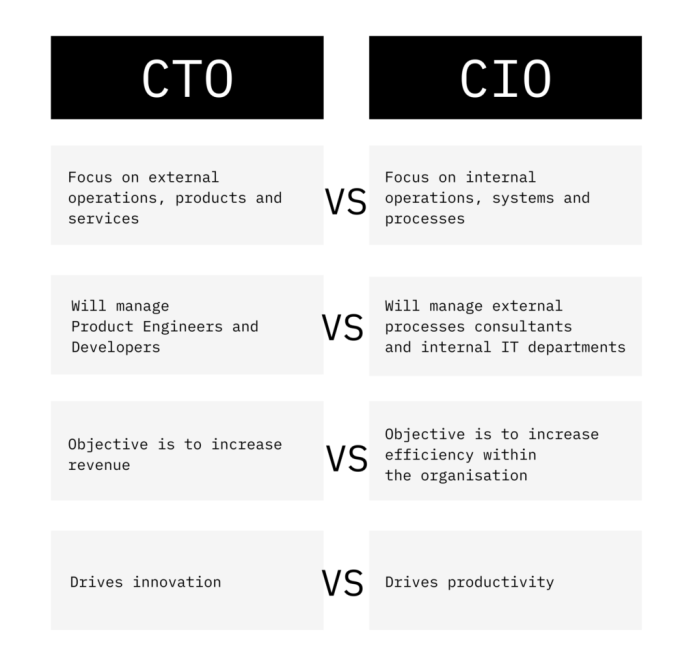
While a CTO focuses on technology strategy to drive innovation and technical advancements, a CIO focuses on information strategy to ensure data integrity, security, and effective utilization for business operations.
CTO vs CIO: Qualifications and Skills
When it comes to qualifications and skills for a Chief Technology Officer (CTO) position, there are several key requirements that candidates need to possess:
- Extensive technical expertise in various areas of technology.
- Strong leadership skills to manage and guide technical teams.
- Excellent problem-solving abilities to address complex technical challenges.
- Strategic thinking and vision to align technology with business goals.
- Experience in implementing and overseeing technology projects.
On the other hand, for a Chief Information Officer (CIO) role, the educational background often needed includes:
- A bachelor's degree in computer science, information technology, or a related field.
- Advanced degrees such as a master's in business administration (MBA) can be beneficial.
- Certifications in areas like project management or IT governance may also be required.
- Experience in managing IT departments and aligning technology with business objectives.
Technical expertise plays a significant role for a CTO compared to a CIO due to the nature of their responsibilities. A CTO is more focused on the technical aspects of technology, such as developing and implementing new systems, while a CIO has a broader role that involves aligning technology with the overall business strategy.
However, both positions require a deep understanding of technology and its impact on the organization.
CTO vs CIO
When it comes to the salaries of Chief Technology Officers (CTOs) and Chief Information Officers (CIOs), there are notable differences that reflect their distinct roles and responsibilities within organizations.
Salary Comparison
CTOs and CIOs are both high-ranking executives in the technology field, but their salaries can vary based on several factors, including industry, company size, and level of experience.
- On average, CTOs tend to earn more than CIOs due to the technical expertise and strategic vision required for the role. According to data from Payscale, the average salary for a CTO in the United States is around $169,430 per year, while the average salary for a CIO is approximately $160,000 per year.
- In the tech industry, CTOs typically command higher salaries compared to CIOs, as they are responsible for overseeing the development and implementation of new technologies and innovations. CTOs in the tech sector can earn well above the national average, with some reaching salaries of $200,000 or more.
- On the other hand, CIOs play a crucial role in managing an organization's information technology systems and infrastructure. While their salaries may be slightly lower than CTOs on average, CIOs in industries such as finance and healthcare can still earn competitive salaries ranging from $150,000 to $180,000 annually.
Factors such as location, company performance, and individual qualifications can also impact the salary discrepancies between CTOs and CIOs.
Final Wrap-Up
Wrapping up our discussion on CTO vs CIO: What’s the Difference and Who Earns More?, it's evident that these roles are pivotal in shaping technological landscapes. By understanding the nuances between CTOs and CIOs, one can appreciate the diverse skill sets and expertise each brings to the table, ultimately influencing their earning potentials in intriguing ways.
FAQs
What are the key responsibilities of a CTO compared to a CIO?
A CTO primarily focuses on technology strategy and innovation, while a CIO concentrates on information strategy and management within an organization.
What qualifications are typically required for a CTO position?
CTOs usually need a strong background in technology, extensive experience in IT, and excellent leadership skills.
How do the average salaries of CTOs and CIOs differ?
On average, CTOs tend to earn more than CIOs due to their specialized technical expertise and strategic roles in driving technology initiatives.


![20 Best Online Computer Information Systems Degrees [2025 CIS Degree Guide]](https://technology.fin.co.id/wp-content/uploads/2025/10/colleges-best_1910-120x86.png)

![Is Computer Information Systems a Good Major? [2025 Guide]](https://technology.fin.co.id/wp-content/uploads/2025/10/computer-information-systems-careers-2-120x86.jpg)